Church of Santi Luca e Martina (San Luca and Santa Martina)
Ecclesiae Sancti Lucae et Sanctae Martinae , Ecclesiae S.S. Lucae et Martinae , Ecclesiae Sancti Lucae in Sancta Martina , Ecclesia Sanctorum Lucae et Martinae , Chiesa di Santo Luca In Santa Martina, Ecclesia Sancti Lucae et Sanctae Martinae , Ecclesia Sancti Lucae In santa Martina , Ecclesia Sancti Lucae In Sancta Martina , ecclesia Sancti Luca in , Ecclesiae Sancti Lucae In dicta Ecclesia Sanctae Martinae
The current Church of Santi Luca e Martina is the result of a laborious effort undertaken by the artist Pietro da Cortona (1596/7‒1669), who served as principe of the Accademia di San Luca at several points during his career. His life is literally intertwined with that of the institution, since he prepared a burial place for himself in the crypt of the church. The documents currently presented on this website, however, concern not the church built after Cortona’s design starting in the 1630s but the structure that predated his intervention. In 1588, when the artists moved in, the Church of Santa Martina was, as visual evidence attests, an amalgamation of architectural strata going back to ancient times. 1
Whereas we know that the artists gained the new site in the Roman Forum in December 1588 after being removed from the Church of San Luca near the basilica of Santa Maria Maggiore a few years earlier at the request of Pope Sixtus V (reigned 1585‒1590), one question that remains unanswered is whether the pontiff ever compensated the painters for the monetary loss incurred from what seems to have been extensive refurbishment of San Luca not long before its demolition. Another question regards who was behind the institution in the transition years from the location near Santa Maria Maggiore to the Forum. The story of the transfer is usually told in terms of replacement, but if the Church of San Luca on the Esquiline was razed soon after Felice Peretti acceded to the pontifical throne as Sixtus V, there was a hiatus of a few years when the Congregazione di San Luca did not have a building in which to carry out its meetings, professional functions, and religious services. It may be that not only Girolamo Muziano—the driving force behind the guild of painters and the burgeoning notion of an Accademia before his death in 1592—but also his younger fellow artist and former protégé Cesare Nebbia played an interceding role on behalf of the painters.2 Although Muziano enjoyed preeminence in papal commissions under Pope Gregory XIII (reigned 1572‒1585), Nebbia worked intensively on Sixtus V’s major artistic commissions, often as a leader (for instance, at the Lateran Palace). In this capacity, he may have been sufficiently close to pontifical advisors to try to advance the artists’ cause.
The new location in the Forum has typically been seen as somehow less attractive and dictated by the urge to revive a decrepit zone of the city. First of all, it is worth pointing out that from the viewpoint of civic administration, the new location was on the boundary of the same rione of the city as the old one, the Rione dei Monti. Its borderline situation emerges in several documents in which it is identified as belonging to both Rione dei Monti and Rione Campitelli.3 Although the area to the northeast of the Church of Santa Martina was undergoing extensive urban transformation, the Forum, toward which the church opened, functioned as a cattle pasture (hence its epithet, Campo Vaccino). At the same time, period sources referred to the great importance that the area in front of the churches of Sant’Adriano and Santa Martina (later Santi Luca e Martina) had enjoyed in ancient Rome. According to tradition, this very spot was “the navel of Rome and of the entire world.”4 Whether or not artists were initially aware of the status of the site, their familiarity with such opinions could have subsequently bolstered their claims for the significance of the location of the Accademia’s new seat.
Period sources often call the church that preceded the unitary building erected after Cortona’s plans the Church of San Luca in Santa Martina, implying a complex of structures in which one was dedicated to the patron saint of painters. Although, most probably because of the new dedication of the church conjointly to Santi Luca e Martina, this spatial arrangement apparently dissipated, documents indicate that the artists continued to conceive of the churches as distinct. Like their neighbors, the Falegnami (carpenters), who decided to build two separate establishments within a unitary structure for the Church of San Giuseppe dei Falegnami and the Church of San Pietro in Carcere, the Accademia members did not collapse the two dedications to Saint Martina and Saint Luke within a single monument. Pietro da Cortona’s will (c. 1669) attests to the division between the lower, underground Church of Santa Martina and the upper Church of San Luca.5 A 1634 document conserved in the Archivio di San Luca also refers to the Church of Santi Luca e Martina as two separate entities in the context of the decision to permit Pietro da Cortona to do “whatever he wanted with the underground chapel of Santa Martina.”6
It is also intriguing that even though the adjacent and much more capacious Church of Sant’Adriano was vacant when Sixtus V assigned Santa Martina to the artists, the pontiff chose the latter as an adequate venue for the Accademia. The choice may have reflected the relatively small size of the artists’ previous church, San Luca. In an 18th-century manuscript, Giovanni Mario Crescimbeni mentioned that the artists had asked for Santa Martina during the pontificate of Sixtus V’s predecessor, Gregory XIII (1572‒1585). The Church of Sant’Adriano did enter into the pontiff’s plans for urbanizing the area, but it was instead entrusted to the Brothers of Santa Maria della Mercede in 1589. Santa Martina functioned as a parish church at the time of the transfer, and thus, as period sources record, this arrangement necessitated distributing the parochial designation to three neighboring churches: San Nicola in Carcere, San Lorenzo ai Monti, and Santa Maria in Cosmedin.
Once installed in the Church of Santa Martina, the artists strove to reorganize the structure to satisfy their needs. Documents on this website attest to masonry carried out in 1590.7 In addition, contemporary authors noted changes already implemented in the church. According to Ottavio Panciroli, campaigns to elevate the pavement had already been carried out by 1600.8 In his early history of the Accademia (1604), Romano Alberti referred to a more spacious Church of Santa Martina that was under construction to meet the needs of the institution and to the “accademi[e]” (lectures and drawing classes) taking place in a room contiguous with the church, the so-called fienile.9 Documentary evidence indicates that plans to reconstruct the church preoccupied Ottaviano Mascherino, a member of the Accademia who later endowed the institution with a rich collection of architectural drawings, including his own ideas for a new church.10 Other details not necessarily visible on maps or plans of the period surface from the documents from the first three decades of the 17th century. They attest to constant maintenance of the building: the leveling of the pavement, the repair of the roof, and other interior modifications. Money was raised principally through modest taxation of the members of the academy, the sale of stone from the ancient site on which the church stood, rents, appraisals, and investments.11 A notable case was the selling of two marble istorie, which, according to Flaminio Vacca (1594), were then found in the house of the sculptor “Giacomo Porta.”12 In 1621 the Accademia, at the behest of Antiveduto Gramatica, even contemplated selling the painting of Saint Luke attributed to Raphael in order to use some of the money for repairs and eventual improvement of the church.13 Other information in the documents concerns topographical details, such as the Accademia’s garden, and the religious services that were regularly held at the academy, led by a chaplain who had accommodations in a few rooms of the complex.
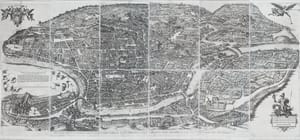
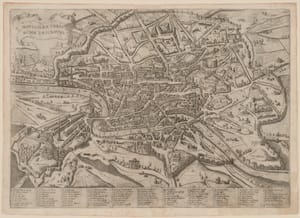
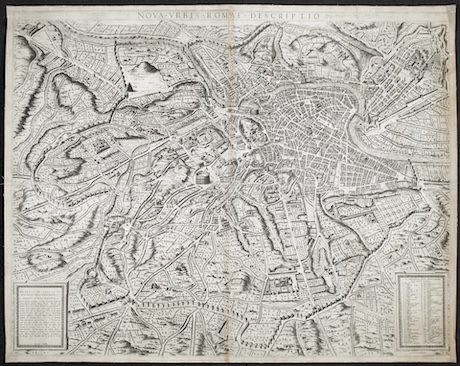
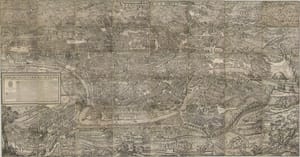
Except for Dupérac’s 1575 engraving capturing the area around the Accademia’s site in the Forum before the transfer of the artists there, few visual sources shed light on the intermediary church, which underwent frequent changes, preceding the building constructed ex novo by Cortona. In Dupérac’s view, the facade suggests neither a large building nor a typical church. Tempesta’s map (1593) shows very little of the facade, whereas Florimi, as pointed out in relation to the Church of Santa Martina, ignored the site altogether despite including the area on the map.14 The church is featured in Matthias Greuter’s map of 1618, but the small dimensions of that map do not allow us to discern architectural elements such as the facade of the church. The isola to which the church belonged, however, is well delineated. The figure of the church appears of medium size in relation to the other churches in the Forum.
While Dupérac’s aerial view of Santa Martina on his map (1577) presents a church-like body that the artists inherited when moving in in 1588, Maggi’s rendition of the site in his map of 1625, despite masking the front of the church (both the facade and part of the nave) behind the Campidoglio tower, attests to the artists’ efforts to improve the edifice. First, the structure distinguishes itself from the surrounding buildings thanks to a larger size and a better-defined shape. Second, it presents even more architectural features specific to a church: a taller, more satisfactorily and naturally illuminated nave against whose visible wall rental or institutional spaces accrued, and a more prominent belfry.
Another source, produced in between Dupérac’s and Maggi’s maps and published in 1615 but probably created in 1612–1613, is a view of the Arch of Septimius Severus in Giacomo Lauro’s Antiquae urbis splendor.15 Since Lauro’s interest was in antiquities, he did not label modern buildings included in his views, and such is the case with an intriguing facade that, given its location, should be that of the Church of Santi Luca e Martina.16 The facade is flat and unadorned but nonetheless meets expectations for a church, with a large, framed entrance and an oculus window.
Visual and documentary information about the interior of this intermediary church is scant, but documents give evidence of interest in decorating the church. From 1618 there was an altar painting by Giovanni Baglione (1566-1643), an important figure in the life of the Accademia who served as principe (prince) from 1617 through 1619.17 Period inventories of the Accademia list a larger and variegated body of works of art in its possession, but these pieces were not part of the church display.
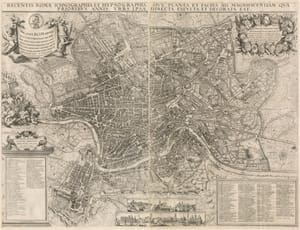
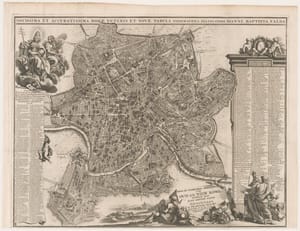
Following documented renovations throughout the first decades of the 17th century, in the mid-1630s Francesco Barberini, wishing to leave his mark as cardinal protector of the Accademia, commissioned a grandiose architectural project from an artist familiar to the Barberini, Pietro da Cortona. Giacomo Pinarolo, in his L’antichita’ di Roma (1713), says that the artists’ undertakings on the church before the Barberini project had ruined the building.18 How this assessment came down to Pinarolo almost a century later remains a conundrum, but the desire for a much-needed functional church must have been acute and, as such, echoes of it transmitted through time. Cortona’s building erased the decades of strife, starting from scratch. His Church of Santi Luca e Martina is a much better-known chapter in architectural history than was its predecessor. It is worth noting that the artist was involved in the reconstruction of the church at the same time that he was engaged in frescoing the Salone of the Palazzo Barberini. Upon the discovery and verification of the relics of Santa Martina, Cardinal Francesco Barberini and his uncle, Pope Urban VIII (reigned 1623–1644), became interested in financing the high altar.19 Discussions for the new church began in 1635. Even as late as 1689, Filippo Titi reported that the church was still incomplete.20 On the other hand, the maps by Giovanni Battista Falda (1676), Joachim von Sandrart (1677), Jan van Vianen (1694–1699) recorded a structure complete on the exterior and whose imposing stature dominated over the neighboring churches in the Roman Forum for the first time.21
~ Silvia Tita, revised August 2021
Italian version
Chiesa dei Santi Luca e Martina (San Luca e Santa Martina)
L'attuale Chiesa dei Santi Luca e Martina è il risultato di un laborioso sforzo intrapreso dall'artista Pietro da Cortona (1596/7-1669). La vita di Cortona si è letteralmente intrecciata con quella dell'istituzione. Si pensi solo al suo ruolo di principe dell'Accademia di San Luca coperto dall’artista per diversi periodi nel corso della sua carriera e al suo luogo di sepoltura preparato da egli stesso nella cripta della chiesa. I documenti inclusi su questo sito web, tuttavia, non riguardano la chiesa costruita conforme al progetto di Cortona a partire dal 1630, bensì la struttura antecedente a questo maggiore intervento. Fonti visive illustrano che nel 1588, quando gli artisti vi si trasferirono, la Chiesa di Santa Martina si presentava come una fusione di strati che risalivano a vari tempi antichi o più recenti.1
Mentre è noto che gli artisti ottennero il nuovo sito nel Foro Romano nel dicembre 1588 dopo essere stati rimossi dalla Chiesa di San Luca vicino alla basilica di Santa Maria Maggiore alcuni anni prima su richiesta di papa Sisto V (1585-1590), rimane ancora da chiarire qualora gli artisti furono mai ricompensati dal pontefice per il danno monetario in seguito dalla demolizione di San Luca avvenuta poco dopo un’apparentemente complessiva ristrutturazione. Un'altra cosa importante è capire quali artisti erano influenti nell'istituzione durante il periodo di transizione dalla sede vicina a Santa Maria Maggiore a quella nel Foro Romano. La storia del trasferimento è spesso raccontata in termini di sostituzione. Comunque, in caso che la Chiesa di San Luca sull'Esquilino fosse demolita subito che Felice Peretti diventò papa, dunque, per pochi anni, la Congregazione di San Luca mancò un edificio in cui svolgere i suoi incontri, programmi e servizi religiosi. Può darsi che non solo Girolamo Muziano, la forza trainante dell'istituzione prima della sua morte nel 1592, ma anche il suo giovane collega artista ed ex-protetto Cesare Nebbia intercedesse per conto dei pittori.2 Sebbene Muziano abbia dominato le commissioni papali di Gregorio XIII (1572-1585), Nebbia aveva lavorato intensamente alle principali commissioni artistiche di Sisto V, spesso come leader (ad esempio, al Palazzo Laterano). Così, Nebbia potrebbe essere stato abbastanza vicino ai consiglieri pontifici per cercare di far avanzare la causa degli artisti.
La nuova sede nel Foro Romano è stata tipicamente vista come meno invitante e scelta per riqualificare una zona decrepita della città. Prima di tutto, si deve sottolineare che dal punto di vista dell'amministrazione civica, la nuova sede era collocata al confine del Rione dei Monti al quale apparteneva anche San Luca all’Esquilino. La sua caratteristica di confine emerge in diversi documenti in cui è identificata come appartenente sia al Rione dei Monti sia al Rione Campitelli.3 L'area a nord-est della Chiesa di Santa Martina stava subendo una vasta trasformazione urbana, mentre il Foro, verso il quale la facciata della chiesa era orientata, funzionava come zona di pascolo per il bestiame (da cui il suo appellativo, Campo Vaccino). Allo stesso tempo, fonti coeve riferivano al fondamentale ruolo che l'area di fronte alle chiese di Sant'Adriano e Santa Martina (in seguito Santi Luca e Martina) teneva nell'antica Roma. Secondo la tradizione, questo stesso luogo fu "Il Miglio d'oro, l'umbilico di Roma, del Mondo."4 Indipendentemente dal fatto che gli artisti inizialmente fossero o no a conoscenza dello status del sito, ulteriormente la loro eventuale familiarità con tali opinioni avrebbe potuto sostenere la causa del valore simbolico della posizione topografica dell'Accademia.
Fonti d'epoca spesso citano la chiesa che precedette l'edificio unitario eretto secondo i piani di Cortona come la Chiesa di San Luca in Santa Martina; dunque, una denominazione che presuppone un complesso di strutture in cui uno spazio era dedicato al santo patrono dei pittori. Anche se, molto probabilmente a causa della nuova dedicazione della chiesa congiuntamente ai Santi Luca e Martina, questa disposizione spaziale apparentemente svanì, gli artisti continuarono a ritenere le chiese come distinte come i documenti testimoniano. Alla stregua dei loro vicini, i falegnami, che decisero di costruire per la Chiesa di San Giuseppe dei Falegnami e la Chiesa di San Pietro in Carcere due spazi separati all'interno di una struttura unitaria, i membri dell'Accademia concepirono le due dediche a San Martina e San Luca all'interno di un unico edificio. Il testamento di Pietro da Cortona (c. 1669) attesta la divisione tra la sotterranea Chiesa di Santa Martina e la superiore Chiesa di San Luca.5 Anche un documento del 1634 conservato nell'Archivio di San Luca riguardante la decisione di consentire a Pietro da Cortona di fare "quello che voleva con la cappella sotterranea di Santa Martina" si riferisce alla Chiesa dei Santi Luca e Martina come formata da due entità separate.6
È interessante che, nonostante l'adiacente e molto più spaziosa Chiesa di Sant'Adriano era vacante, Sisto V considerò Santa Martina come una sede adeguata alla missione dell’Accademia. Le dimensioni relativamente ridotte della precedente chiesa degli artisti, San Luca all’Esquilino, potrebbero aver indicato la soddisfazione degli artisti con uno spazio modesto. In un manoscritto settecentesco, Giovanni Mario Crescimbeni scriveva che gli artisti avevano già chiesto Santa Martina durante il pontificato del predecessore di Sisto V, Gregorio XIII (1572-1585). La Chiesa di Sant'Adriano fu comunque inclusa nel piano di Sisto V per l'urbanizzazione dell'area, ma fu invece affidata ai Padri di Santa Maria della Mercede nel 1589. Essendo Santa Martina già chiesa parrocchiale, dopo il trasferimento degli artisti lì—come fonti coeve riferiscono—è stata attuata la distribuzione della designazione parrocchiale a tre chiese vicine: San Nicola in Carcere, San Lorenzo ai Monti e Santa Maria in Cosmedin.
Una volta installati nella Chiesa di Santa Martina, gli artisti si sforzarono di riorganizzare la struttura per soddisfare le loro esigenze. Per esempio, i documenti su questo sito web attestano gli interventi svolti nel 1590.7 Inoltre, gli autori contemporanei osservarono cambiamenti già implementati nella chiesa. Secondo Ottavio Panciroli, lavori per elevare il pavimento furono condotti già prima del 1600.8 Nella sua storia dei primi anni dell'Accademia (1604), Romano Alberti si riferì a una chiesa più spaziosa di Santa Martina che era in costruzione per soddisfare le esigenze dell'istituzione e delle "accademi[e]" (lezioni teoriche e di disegno) tenute in una stanza contigua alla chiesa.9 I documenti indicano che Ottaviano Mascherino, architetto e membro dell'Accademia, si preoccupò della ricostruzione della chiesa e in seguito donò all'istituzione una ricca collezione di disegni architettonici, tra i quali le sue idee per un nuovo edificio.10 Altri dettagli non necessariamente visibili sulle mappe o sui disegni del periodo emergono dai documenti dei primi tre decenni del Seicento che dimostrano la costante manutenzione dell'edificio come il livellamento della pavimentazione, la riparazione del tetto e altre modifiche interne. I soldi furono raccolti principalmente attraverso una modesta tassazione dei membri dell'Accademia, la vendita di materiale lapideo dall'antico sito su cui sorgeva la chiesa, affitti e investimenti.11 Un caso degno di nota fu la vendita di due istorie marmoree, che, secondo Flaminio Vacca (1594), furono poi trovate nella casa dello scultore "Giacomo Porta".12 Nel 1621, l'Accademia, su consiglio di Antiveduto Gramatica, pensò persino di vendere il dipinto di Raffaello (San Luca dipinge la Vergine) al fine di utilizzare parte del denaro per le riparazioni e l'eventuale miglioramento della chiesa.13 Altre informazioni contenute nei documenti riguardano dettagli topografici, come il giardino dell'Accademia, e i servizi religiosi che si tenevano regolarmente presso l'Accademia da un cappellano che alloggiava in alcune stanze del complesso.
Poche fonti visive fanno luce sulla chiesa transitoria che subì frequenti cambiamenti prima della costruzione ex novo dell'edificio progettato da Cortona. La più edificante è l'incisione di Dupérac (1575), mostrata qui nel carosello, dell'area intorno alla Chiesa di Santa Martina prima del trasferimento degli artisti al sito. La facciata non indica né un grande edificio né una chiesa tipica. La mappa di Tempesta (1593) mostra pochissimo della facciata, mentre Florimi, come sottolineato in relazione alla Chiesa di Santa Martina, ignorò del tutto il sito nonostante che illustrasse l'area sulla mappa.14 La chiesa è inclusa nella mappa di Matthias Greuter del 1618, ma le piccole dimensioni di questa mappa non ci permettono di discernere certi elementi architettonici come la facciata della chiesa. L'isola a cui apparteneva, tuttavia, è ben delineata. La chiesa pare di medie dimensioni in relazione alle altre chiese del Foro.
Mentre la vista aerea di Santa Martina di Dupérac (1577) presenta l’edificio ereditato dagli artisti nel 1588 come simile ad una chiesa, la rappresentazione del sito sulla mappa di Maggi (1625), nonostante nasconda la parte anteriore della chiesa (sia la facciata che parte della navata) dietro la torre del Campidoglio, rivela gli sforzi apportati degli artisti per migliorare l’edificio. In primo luogo, la struttura si distingue dagli edifici circostanti grazie a un volume più ampio ed una forma meglio definita. In secondo luogo, essa presenta più caratteristiche architettoniche specifiche di una chiesa: oltre a un campanile più prominente, una navata più alta e illuminata naturalmente da grandi finestre. Dintorno all’edificio sono maturati piccoli spazi per l’affitto o per uso istituzionale.
Un'altra immagine evocativa è una vista dell'Arco di Settimio Severo nello Antiquae urbis splendor di Giacomo Lauro. L’ incisione è stata creata probabilmente nel 1612-1613—dunque tra la mappa di Dupérac e quella di Maggi—ma pubblicata nel 1615.15 Poiché l'interesse di Lauro verteva sulle antichità, gli edifici moderni inclusi nelle sue immagini non sono identificati. Questo è il caso di una facciata affascinante che, data la sua posizione, dovrebbe essere quella della Chiesa dei Santi Luca e Martina.16 La facciata è piatta e disadorna, ma soddisfa comunque le aspettative di una chiesa, con un grande ingresso incorniciato e un oculo.
Le fonti visive e scritte sull'interno di questa chiesa transitoria sono scarse, ma i documenti reperibili dimostrano interesse per la decorazione della chiesa. A partire dal 1618 una pala d'altare di Giovanni Baglione, personaggio notevole dell'Accademia in quegli anni, adornava la chiesa.17 Gli inventari d'epoca dell'Accademia elencano un corpus più ampio e variegato di opere d'arte in suo possesso, ma questi oggetti non erano esposti nella chiesa.
A seguito di documentate ristrutturazioni durante i primi decenni del Seicento, a metà degli anni Trenta del secolo Francesco Barberini, volendo immortalare il suo ruolo di cardinale protettore dell'Accademia, commissionò un grandioso progetto architettonico ad un artista familiare ai Barberini, Pietro da Cortona. Giacomo Pinarolo, nella sua L'antichita' di Roma (1713), ipotizzava che le imprese degli artisti sulla chiesa prima del progetto del cardinale Barberini avessero rovinato l'edificio.18 Le ragioni che indussero Pinarolo a formulare questo giudizio a quasi un secolo di distanza rimangono ignote, ma lo sforzo di creare una chiesa funzionale dovrebbe essere stato acuto e, come tale, i suoi echi si trasmessero nel tempo. L'edificio di Cortona cancellò i decenni di lotta, partendo da zero. La Chiesa dei Santi Luca e Martina progettata da Cortona è un capitolo molto più conosciuto. L'artista fu coinvolto nella ricostruzione della chiesa durante il medesimo periodo nel quale affrescava il soffitto del Salone di Palazzo Barberini. Alla scoperta delle reliquie di Santa Martina, il cardinale Francesco Barberini e suo zio, Papa Urbano VIII (1623-1644), si interessarono al finanziamento dell'altare maggiore.19 Le discussioni per la nuova chiesa iniziarono nel 1635. Nel 1689, Filippo Titi scriveva che la chiesa era ancora incompleta.20 D'altra parte, le mappe di Giovanni Battista Falda (1676), Joachim von Sandrart (1677), and Jan van Vianen (1694-1699) mostrano una struttura completa all'esterno la cui imponenza dominava per la prima volta le chiese adiacenti nel Foro Romano.21
Notes
Footnotes
-
See the entry on the Church of Santa Martina. ↩ ↩2
-
Nebbia was present at the early meetings at the new location in the Forum. See documents on this website under the entry “Cesare Nebbia.” Nebbia was elected principe in 1596–1597. See also the essays by Peter M. Lukehart “Visions and Divisions in the Accademia di San Luca, 1593–1595,” and John Marciari “Artistic Practice in Late Cinquecento Rome and Girolamo Muziano’s Accademia di San Luca” in The Accademia Seminars: The Accademia di San Luca in Rome, c. 1590‒1635, ed. Peter M. Lukehart (Washington, 2009), 160‒195 and 197‒223. [Italian version] Nebbia fu presente ai primi incontri nella nuova sede del Forum (anche nei documenti su questo sito web "Cesare Nebbia"). Nebbia fu eletto principe nel 1596-1597. Vedi anche i saggi di Peter M. Lukehart "Visioni e divisioni nell'Accademia di San Luca, 1593-1595", e John Marciari ("Pratica artistica nel tardo Cinquecento roma e Accademia di San Luca di Girolamo Muziano") in The Accademia Seminars: The Accademia di San Luca a Roma, c. 1590-1635, ed. Peter M. Lukehart (Washington, 2009), 160-195 e 197-223. ↩ ↩2
-
See, for instance, ASR, TNC, uff. 11, 1589, pt. 1, vol. 12, fols. 241r‒v. ↩ ↩2
-
“Il Miglio d’oro, l’umbilico di Roma, del Mondo.” Panciroli 1600, 179. ↩ ↩2
-
See ASR, TNC, uff. 11, 1590, pt. 1, vol. 15, fol. 628r. ↩ ↩2
-
See ASR, TNC, uff. 15, 1624, pt. 4, vol. 102, fols. 210r‒v, 211r‒v, 219r. ↩ ↩2
-
See, for instance, ASR, TNC, uff. 15, 1629, pt. 1, vol. 119, fols. 261r‒v, 278r, and ASR, TNC, uff. 15, 1595, pt. 2, vol. 38, fol. 69r. ↩ ↩2
-
Vacca 1988 (1594), 68. Flaminio Vacca was a member of the Accademia, serving even as principe. These were panels with stories of Marcus Aurelius that were in the end transferred to the Campidoglio. [Italian version] Vacca 1988 (1594), 68. Flaminio Vacca fu membro e brevemente principe dell'Accademia. Si tratta di pannelli con storie di Marco Aurelio che successivamente furono trasferiti in Campidoglio. ↩ ↩2
-
See entry on the Church of Santa Martina. ↩ ↩2
-
There are a few discrepancies in Lauro’s arrangement of the monuments, especially the spatial relationship between the Church of San Pietro in Carcere and the Church of Santi Luca e Martina. [Italian version] Ci sono alcune discrepanze nella disposizione dei monumenti da parte di Lauro, in particolare il rapporto spaziale tra la Chiesa di San Pietro in Carcere e la Chiesa dei Santi Luca e Martina. ↩ ↩2
-
The painting has survived but in poor condition. For the document, see Noehles 1970, 334, doc. 8. [Italian version] Il dipinto è sopravvissuto ma in cattive condizioni. Per il documento, Noehles 1970, 334, doc. ↩ ↩2
-
Titi 1763, 109. See also the important revisionist history of the building in Merz 2008, 53-77. ↩ ↩2
-
By contrast, Sandrart rendered a sketchy, undivided facade comparable to Sant’ Adriano’s. [Italian version]Tuttavia, Sandrart rese una facciata abbozzata, indivisa, paragonabile a quella di Sant'Adriano. ↩ ↩2