Church of Santa Martina
Chiesia di Santa Martina , Beati Martine , ecclesiae Sanctae Martinae , Ecclesia S. Martine , Ecclesia Beate Martino , ecclesiam Sanctae Martinae , Ecclesia Sanctae Martinae , ecclesia Sancte Martine, Chiesiadi Santa Martina , Ecclesia S. Martinae , Chiesa di Sancta Martina , Ecclesia Sancti Martini
In the early modern period, it was believed that the Church of Santa Martina had functioned as the ancient Roman Secretarium Senatus for the Curia Senatus (also known as the Curia Julia), the latter located on the site of what became, in the 7th century, the Church of Sant’Adriano. At this time the Church of Santa Martina was supposed to have been built on the remnants of the Temple of Mars erected by Emperor Augustus (reigned 27 BCE–14 CE).1 This site was identified as a suitable repository for the relics of Santa Martina because the saint’s name sounded as though it derived from Mars (Italian Marte; Latin Mars, Martis). An inscription, still extant at the site in 1600 and often reproduced by coeval sources, celebrated this association : “The virgin Martina wearing a martyr's crown / has the church now Mars has been expelled from here.” 2
There was conflicting information about when the saint’s relics had been transferred to the church and when the church had been consecrated, whether by Pope Sylvester I during the time of the first Christian emperor, Constantine the Great (reigned 307–333), or by Pope Alexander IV (reigned 1254–1261) in 1256 on the occasion of the (re)consecration of the site.3 The former belief underscored the antiquity of the church. In addition, this prestigious identification linked the church to the foundations of early Christianity, a defining period for Rome as the papal city. Such filiation placed the Church of Santa Martina within the papal orbit and, more importantly, connected it to the cultivation of Constantinian sites. It could thus provide the artists of early modern Rome with leverage for generating interest in the site.
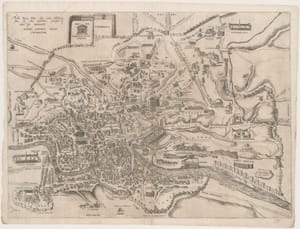
Visual and textual sources give enough information to form an idea about the site’s appearance before 1588, the year Pope Sixtus V (reigned 1585–1590) conceded the church to the artists in exchange for the recently demolished Church of San Luca on the Esquiline Hill.4 Indeed, Santa Martina did not look like a typical church. Pirro Ligorio’s map presents a building with a uniform facade, bracketed by the statue of Marforius and the church of Sant’Adriano.
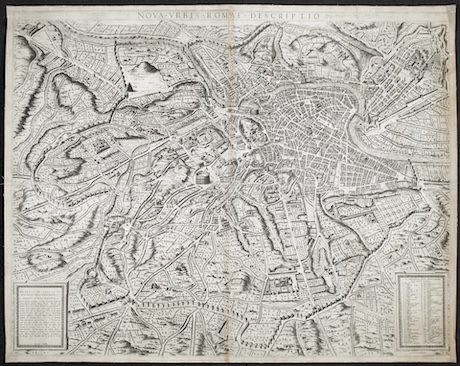
However, as one can see in the detail from Étienne Dupérac’s engraving of the area of the Roman Forum that includes the church, the facade, which faced the Forum, presented a nonuniform, domestic aspect. A row of two-story buildings of different sizes makes the entrance to the church difficult to discern. On the other hand, in his map of Rome published two years later, Dupérac depicted the structure from an aerial view like a church, analogously to its neighbor Sant’Adriano. Compared with Dupérac's earlier view of the area, that may have been the case for the roof (labeled letter C), whereas the façade masked the function of the site. In fact, in his Delle chiese di Roma (1600), Ottavio Panciroli referred to the church as “hidden.”5
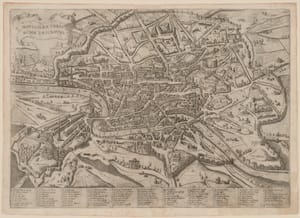
It is possible that this nondescript condition caused 16th-century authors of guidebooks to Rome, such as Girolamo Francini (1566), to overlook the Church of Santa Martina when enumerating the other churches in the Forum: San Pietro in Carcere, Sant’Adriano, San Lorenzo in Miranda, Santi Cosma e Damiano, and Santa Maria Nova.6 Similarly, Florimi obliterated the site from his map of Rome. Although an excuse could be formulated when considering that all churches in the Roman Forum are almost unrecognizable due to Florimi’s abundant usage of hatching, the void corresponding to the site of Santa Martina designates it as unimportant. Both the unusual shape and unimpressive size of the structure may have contributed to Florimi’s decision not to indicate the site.
In Dupérac’s engraving, above the entrance to the complex is a small rectangular panel in which the silhouette of a figure can be distinguished. This may have been an image of Santa Martina, placed there to mark the entrance to the church.7 Extant drawings by Baldassare Peruzzi and Antonio da Sangallo present a unique nave plan preceded by an atrium.8 But as the elevations reveal, the atrium must have been partly filled in with house-like structures. Changes around the site had been implemented even before the painters initiated their work on the church, but they were confined to the exterior. After the replanning of the area under the supervision of Cardinal Alessandrino (Michele Bonelli) in the 1580s, a street was created between the Church of Santa Martina and the adjacent Church of Sant’Adriano. Initiated by Cardinal Alessandrino under Pope Gregory XIII, the project could not have continued without the approval of his successor, Sixtus V.
The Accademia would have to cope with extensive maintenance work on the church throughout the next decades, but in his Origine, et progresso dell’Accademia del Dissegno, de pittori, scultori, et architetti di Roma (1604), Romano Alberti expressed satisfaction with the site for its capaciousness and ability to host an academy.9 Sixtus V’s decision to cede Santa Martina to the Accademia is by now a historical given. It is worth noting, however, that in his book on his own Villa Montalto, Vittorio Massimo quotes a manuscript on the Church of San Nicola in Carcere by Giovanni Mario Crescimbeni (1663–1725).10 There, Crescimbeni relates an alternative history of the transfer of the artists from the Esquiline to the Forum. According to his account, the painters themselves wanted to change the location of their headquarters from the Church of San Luca to the Church of Santa Martina as early as the pontificate of Gregory XIII. This account suggests greater agency to the Università dei Pittori, the guild to which the painters belonged before the founding of the Accademia, in the acquisition of the church.
~ Silvia Tita, revised August 2021
Italian version
Chiesa di Santa Martina
Nell’età moderna, si credeva che la Chiesa di Santa Martina avesse funzionato come l'antico Secretarium Senatus romano per la Curia Senatus (nota anche come Curia Giulia), quest'ultima situata sul sito di quella che nel VII secolo divenne la Chiesa di Sant'Adriano. Si credeva anche ch’essa fosse stata costruita sui resti del Tempio di Marte eretto dall'imperatore Augusto (27 a.C.-14 d.C.). 1 Questo sito era giudicato come un deposito adatto per le reliquie di Santa Martina perché il nome della santa sembrava derivato dalla radice della parola Marte (dal latino Mars, Martis). Un'iscrizione, ancora esistente nel sito nel 1600 e spesso riprodotta da fonti coeve, celebrò questa associazione: "Martyrij gestans virgo Martina coronam / Eiecto hinc Martis numine, temala tener".2
La prima ipotesi sottolineò l'antichità della chiesa. Inoltre, questa prestigiosa identificazione collega la chiesa al quarto secolo del Cristianesimo, un’epoca decisiva per Roma come città papale. Via tale filiazione la Chiesa di Santa Martina entrava nell'orbita papale e, significativamente, in quella dei siti costantiniani. Quindi, essa potrebbe aver fornito agli artisti una risorsa per generare interesse per il sito.
Fonti visive e scritte danno sufficienti informazioni per farsi un'idea dell'aspetto del sito prima del 1588, anno in cui papa Sisto V (1585-1590) concesse la chiesa agli artisti in cambio della recentemente demolita Chiesa di San Luca sul Colle Esquilino.4 Infatti, Santa Martina non sembrava una chiesa tipica. La mappa di Pirro Ligorio presenta un edificio con una facciata uniforme, situato tra la statua di Marforio e la Chiesa di Sant'Adriano.
Tuttavia, come si può vedere nell’incisione dell'area del Foro Romano intorno alla chiesa disegnata da Étienne Dupérac nel 1575, la facciata, che si affacciava sul Foro, era irregolare e di aspetto piuttosto domestico. Edifici a due piani di diverse dimensioni rende difficile discernere l'ingresso alla chiesa. D'altra parte, nella sua mappa di Roma pubblicata due anni dopo, Dupérac rappresentò la struttura come una chiesa, analogamente alla vicina Sant'Adriano, grazie alla vista aerea dell’area. In confronto alla sua precedente incisione, il tetto della chiesa (lettera C) potrebbe essere stato di una forma tipica, mentre la facciata mascherava la funzione del sito. Infatti, Ottavio Panciroli (I tesori nascosti nell'alma città di Roma, 1600) trovava la chiesa "nascosta".5 È possibile che questa condizione anonima abbia indotto gli autori cinquecenteschi delle guide di Roma, come Girolamo Francini (1566), a trascurare la Chiesa di Santa Martina al contrario delle altre chiese del Foro che invece vengono elencate: San Pietro in Carcere, Sant'Adriano, San Lorenzo in Miranda, Santi Cosma e Damiano e Santa Maria Nova.6 Allo stesso modo, Florimi ignorò il sito nella sua mappa della città. Una scusa per la sua decisione potrebbe essere trovata nel fatto che le chiese del Foro Romano sono quasi irriconoscibili a causa dell'abbondante uso del tratteggio da parte di Florimi. Comunque, il vuoto corrispondente al sito di Santa Martina lo designa come irrilevante. Sia la forma insolita che le dimensioni insignificanti della struttura potrebbero aver contribuito alla scelta di Florimi di ometterla.
L'incisione di Dupérac mostra sopra l'ingresso del complesso un piccolo pannello rettangolare in cui si può distinguere la sagoma di una figura. Questa potrebbe essere stata un'immagine di Santa Martina, lì posta per segnalare l'ingresso alla chiesa.7 Disegni della chiesa di Baldassarre Peruzzi e Antonio da Sangallo presentano una pianta a navata unica preceduta da un atrio.8 Ma le elevazioni rivelano che l'atrio deve essere stato parzialmente occupato da strutture simile a case. Certi cambiamenti intorno al sito precedettero di poco gli interventi architettonici dei pittori sulla chiesa. Dopo la pianificazione dell'area sotto la supervisione del cardinale Alessandrino (Michele Bonelli) nel 1580, fu creata una strada tra la Chiesa di Santa Martina e l'adiacente Chiesa di Sant'Adriano. Anche se iniziato dal cardinale Alessandrino sotto papa Gregorio XIII, il progetto non avrebbe potuto continuare senza l'approvazione del suo successore, Sisto V.
L'Accademia aveva dovuto affrontare ampi lavori di manutenzione della chiesa originaria per circa cinque decenni, ma nella sua Origine, et progresso dell'Accademia del Dissegno, de pittori, scultori, et architetti di Roma (1604), Romano Alberti espresse soddisfazione per il sito per la sua capacità di ospitare un'accademia.9 La decisione di Sisto V di cedere Santa Martina all'Accademia è ormai un dato storico. Merita notare, tuttavia, che nel suo libro sulla propria Villa Montalto, Vittorio Massimo cita un manoscritto sulla Chiesa di San Nicola in Carcere di Giovanni Mario Crescimbeni (1663-1725) in cui Crescimbeni racconta una storia alternativa del trasferimento degli artisti dall'Esquilino al Forum10. Secondo Crescimbeni, gli stessi pittori avrebbero voluto cambiare la posizione della loro sede dalla Chiesa di San Luca alla Chiesa di Santa Martina già durante il pontificato di Gregorio XIII. Questo resoconto suggerisce una manifestazione di agency nell'acquisizione della chiesa da parte dell'Università dei Pittori, la corporazione a cui appartenevano i pittori prima della fondazione dell'Accademia.
Notes
Footnotes
-
“Martyrij gestans virgo Martina coronam, / Eiecto hinc Martis numine, templa tenet.” See, for instance, Panciroli 1600, Totti 1638, and Vasi 1753. Sometimes an Italian translation accompanied the Latin inscription. ↩ ↩2
-
Compare Panciroli’s and Totti’s versions of the early history of the site. ↩
-
After the installation of the artists in Santa Martina, the parochial community of the church was divided among three neighboring churches: San Nicola in Carcere, San Lorenzo ai Monti, and Santa Maria in Cosmedin. ↩ ↩2
-
Additionally, in Dupérac’s image, the letter C marking the church appears twice, once near the nave and again just below the entrance. ↩ ↩2
-
For reproductions of these plans, see Krautheimer et al. 1937-1977, 3:84–85. ↩ ↩2
-
“Sudetto luogo di Santa Martina dove di già si è principiata la nostra chiesa di San Luca … assai luogo capace per poter ridure insieme, e fare una nobilissima Accademia.” Alberti 1604, 2. ↩ ↩2