Toward a Documentary History of the Accademia di San Luca
Our understanding of the early history of the Accademia di San Luca has long depended on the initial published accounts, one written at the beginning of the 17th century by the academy’s secretary, Romano Alberti, and the other at the beginning of the nineteenth century by then-secretary Melchiorre Missirini.1 In the two hundred years that separate these chronicles, many of the documents that the Accademia kept for its own records had been lost. We have several anchors—including the brief from Pope Gregory XIII in 1577 and the bull from Pope Sixtus V in 1588 calling for the founding of an academy for the painters and sculptors of Rome, as well as the two earliest publications, both under the authorship of Alberti, Trattato della nobiltà della pittura (1585) and Origine e progresso dell’Academia del Dissegno, de pittori, scultori, et architetti di Roma (1604), referenced above—but there have, until recently, been many gaps in the narrative.2 The History of the Accademia di San Luca, c. 1590‒1635: Documents from the Archivio di Stato di Roma undertakes as one of its principal goals the restitution of the notarial records of the first 45 years of the Accademia that were once in the institution’s archive.
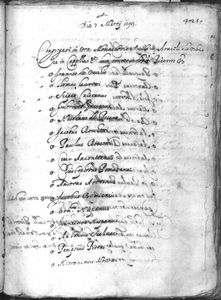
Whereas many of these documents concern property rentals, collection of dues and alms, appraisals, and internal disputes, in other cases we find evidence of monumental decisions. One of the most important of these is the document that proposes to found an Accademia (formare una Academia) on March 7, 1593, when the six deputies—Giovanni de Vecchi, Tommaso Laureti, Scipione Pulzone, and Federico Zuccaro, as well as possibly Nicolò da Pesaro (il Trombetta) and Jacopo Rocchetti—presented to the members of the “Congregazione delli Pittori di Roma” the principal tenets for the new institution.3 Among these were the intention that it serve for the benefit of instruction for giovani (young boys) and for all those who wished to follow the correct path of the study of painting. The Accademia also provided support for youths in financial need. Second, the members of the Accademia were meant to be free from a guild and any mechanical or servile obligations. The document further addressed the meaningful work to be produced by the academicians: paintings that would inspire piety and devotion as, it was then understood, the holy church fathers intended. In like fashion, the deputies proscribed, for reasons of reverence and decorum, that members hang paintings of saints or even secular works from the windows of their workshops or in public. Those who practiced painting in workshops (as opposed to private studios) were admitted as members of the Compagnia (confraternity), but not the Accademia. Finally, the deputies pointed to the vile state in which their formerly exalted profession then found itself and offered an alternative vision that would inspire the youths to work hard and imitate the most esteemed artists in order to practice painting nobly.
The early years of the Accademia di San Luca bear witness to the fitful growing pains of an inchoate institution. Although statutes were created in the 1590s, they were not officially promulgated until 1607 and were finally published only in 1609.4 In addition, the teaching curriculum that Zuccaro introduced in 1593‒1594, which faltered after his tenure as principe (prince), was short lived.5 If Romano Alberti is to be believed, the succeeding principi, one per year from 1595 through 1600, did not focus on education.6 Unlike the Accademia del Disegno in Florence, where the luogotenente invigilated at the meetings of the artist members, the cardinal protector of the Accademia rarely set foot in the academy or in the confraternal church of San Luca until the 1620s. As argued in The Accademia Seminars: The Accademia di San Luca in Rome, c. 1590‒1635, the first three decades of the institution’s history are not marked by a unified vision; rather, they attest to the relative energy, vision, and engagement of both its princes and its protectors to effect change.7
A series of documents from 1624 chronicles the removal of the principe Antiveduto Grammatica on October 24, 1624 for reasons related in part to his tendency to make consequential decisions through the select group of academicians called the colletta, rather than through the larger body of the Accademia, and in part to his desire to sell their prized possession: Raphael’s (or so it was then thought) Saint Luke Painting the Madonna and Child in the Presence of Raphael.8 Grammatica was relieved of his duties and replaced by a French painter, Simon Vouet, who remained as prince until June 29, 1627 when he was recalled to France by the king, Louis XIII.9
This period also marks important changes to the powers of the Cardinal Protector Francesco Maria del Monte and the transition to the reign of Pope Urban VIII Barberini, who understood how useful the Accademia could be to his cultural agenda. During those nearly three years of service, Vouet reformed the educational program of the Accademia and created a provisional détente between the artists from Northern Europe and their Italian peers.10 This was the period, too, when the new cardinal protector, Francesco Barberini, made his (and the pope’s) will known to the Accademia, occasionally through his secretary, the antiquarian Cassiano dal Pozzo.
The Accademia was henceforth both less autonomous and more financially secure. In 1634 the principe Pietro da Cortona ordered excavations of the crypt of the Church of San Luca, where the remains of Santa Martina and other saints were miraculously discovered. However skeptically we might now view these discoveries, they were sufficiently convincing to elicit a 6,000-scudi donation from Cardinal Francesco Barberini.11 The building of Cortona’s imposing Church of Santi Luca e Martina, begun in 1635, raised the Accademia’s profile and asserted its presence in the Eternal City.
Notes
Footnotes
-
Romano Alberti, Origine et progresso dell’Academia del Dissegno, de pittori, scultori, et architetti di Roma (Pavia, 1604); Melchiorre Missirini, Memorie per servire alla storia della Romana Accademia di S. Luca fino alla morte di Antonio Canova (Rome, 1823). ↩
-
The brief of 1577 and the bull of 1588 are transcribed from Missirini’s Italian translations (1823, 20‒21; 23‒26) in Lukehart 2009, app. 1, 348–349; app. 2, 350–352. Romano Alberti, Trattato della nobiltà della pittura composto ad istantia della venerabil’ Compagnia di San Luca et nobil’ Academia delli pittori di Roma (Rome, 1585). For Alberti’s early history of the Accademia, see previous note. ↩
-
For a fuller treatment of the issues discussed in this summary, see Peter M. Lukehart, “The Accademia di San Luca between Educational and Religious Reform,” in The Italian Academies, 1525–1700: Networks of Culture, Innovation, and Dissent, ed. Jane E. Everson, Denis V. Reidy, and Lisa Sampson (Oxford, 2016), 170–185. ↩
-
Alberti 1604, 6–13; “Statuti originali in tempo di Paulo 5.o," Archivio Storico dell’Accademia di San Luca; published as Ordini dell’Accademia de Pittori et Scultori di Roma (Rome: Carlo Vullietti, 1609). ↩
-
Alberti 1604, 25–78 (curriculum and accademie [lectures]). ↩
-
Alberti 1604, 78–80. ↩
-
Peter M. Lukehart, “Visions and Divisions in the Accademia di San Luca, 1593-1595,” in The Accademia Seminars: The Accademia di San Luca in Rome, c. 1590-1635, ed. Peter M. Lukehart (Washington: National Gallery of Art, 2009): 160-185, esp. 185. ↩
-
Stefania Ventra, Restauri di dipinti nel Novecento: Le posizioni nell’Accademia di San Luca, 1931–1958 (Università di Roma, La Sapienza, Studi Umanistici-Arti, 2014), esp. 88–108. ↩
-
Elisa Camboni, “Antiveduto Grammatica: un principe-imprenditore; L’Accademia di San Luca nei primi anni del Seicento,” Annali delle arti e degli archivi: Pittura, scultura, architettura 3 (2017): 211–216 provides an insightful reading of the events; see also Peter M. Lukehart, “The Roman Connection: The Accademia di San Luca as an Exemplum for the Académie royale de peinture et de sculpture,” in Accademie artistiche tra eredità e dibattiti contemporanei, ed. Jérome Delaplanche, Sarah Linford, and Francesco Moschini, Conference Proceedings of the Académie de France à Rome—Accademia di Belle Arti—Accademia di San Luca (Rome, forthcoming). For a different interpretation, see R. Ward Bissell, “Raphael and the Accademia di San Luca in Rome,” Artibus et Historiae 32, no. 63 (2011): 55–72. ↩
-
Peter Lukehart is completing a study of the major educational reforms undertaken by the Accademia from the late sixteenth through the late seventeenth century, in “(Ri)Scrivere ‘l’Origine e progresso’ dell’Accademia di San Luca,” in Storie e controstorie delle Accademie del Disegno fra Firenze, Bologna, Roma, ed. Vita Segreto (Rome, forthcoming). ↩
-
Karl Noehles, La chiesa di Santi Luca e Martina nell’opera di Pietro da Cortona (Rome, 1970), 99; Joseph Connors, review of Pietro da Cortona e il disegno, Journal of the Society of Architectural Historians, 57, no. 3 (1998): 318–321, esp. 320. See also Silvia Tita's essay on the Church of Santi Luca e Martina. ↩