Brief Early History of the Accademia di San Luca
A timeline tracing key moments of the foundation of the Accademia di San Luca, its building, and its first principi.
1585 – 1599
1585An early treatise in paintingRomano Alberti published the Trattato della nobiltà della pittura, which laid out an argument for the nobility and liberality of the art of painting.
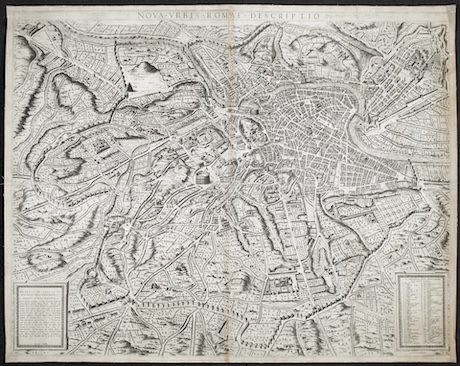
1588A new building for the Guild of PaintersThe family of Pope Sixtus V (Perretti) built their new palace adjacent to the basilica of Santa Maria Maggiore on the Esquiline Hill, razing the former church of the Guild of Painters dedicated to San Luca, their patron saint. The pope offered a new site for the painters at the church of Santa Martina (c. seventh century CE) in the Roman Forum, which was formerly believed to have been built on top of the Temple of Mars in the Forum of Mars, now identified as the site of the Secretarium Senatus. In the same year, Sixtus V issued a Bull declaring the foundation of the Accademia di San Luca, for the “noble arts” of painting, sculpting, and drawing.
1589Supporting young artistsIssues of the education and support of the young artists are mentioned in the wills of several artists who figured prominently in the early history of the Accademia: Girolamo Muziano, Federico Zuccari, and Tommaso della Porta (c. 1550-1606). Of these early champions, only Muziano’s estate yielded enough funds to serve the Accademia’s mission. Additional funding came from the sale of travertine on the site of the church of Santa Martina; and the establishment of the 2% tax on appraisals in 1589.
1593The Accademia di San Luca is establishedOn 18 October 1593, the Feast Day of St. Luke, the Accademia elected its first principe, Zuccari, a painter whose experience with the Accademia del Disegno in Florence (founded thirty years earlier) in its first decades, the Accademia degli Insensati (estab. 1561) in Perugia, and the Compagnia di San Giuseppe in Terrasanta (also known as the Virtuosi al Pantheon, estab. 1542)—of which he was reggente—had the experience and the ambition to create a pedagogical program for artists.
The early decades of the XVII century at the Accademia di San Luca
As first steps, the academicians established statutes and pursued economic stability for the Accademia.
1600 – 1640
1607The StatutesFrom the outset of the formal academy, the members established statutes that defined the roles of the officers and governed the process of their election. Written in 1607, the first extant and complete set of statutes are housed in the Archivio Storico dell’Accademia di San Luca; when published in 1609, they also became the initial promulgated statutes of the organization. These statutes set out many of the rules that governed the Accademia’s membership for generations, such as the establishing the minimum age to be elected prince, at 30 years.
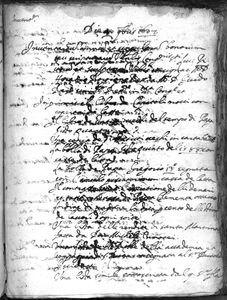
1624A period of stabilityThe French painter Simon Vouet (1590-1649) was elected principe in 1624, just after Urban VIII ascended to the Papacy. This confluence of an extremely able prince—who served for three years until called back to Paris by Louis XIII—and a powerful new Cardinal Protector, Francesco Barberini (1597-1679), led to a period of relative stability and eventual financial liquidity in the Accademia. One of the first orders of business for Vouet was the reform of the educational program, for which prominent members of the Accademia rotated every few months as instructors for the giovani. Further, with the purchase of two homes flanking the church of San Luca in Santa Martina—as it was then known—this was a period marked by possible ambitions for more extensive rebuilding of the confraternal church. Lacking funds, however, the academicians decided in 1624 to complete the project according to the structure’s then-present footprint and framework.
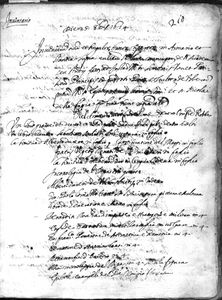
1634Consolidation of existing buildingsPainter and architect Pietro Berrettini da Cortona (1596/97-1669) was elected prince and granted permission to restore the lower church, during the process of which they discovered what were then thought to be the remains of early Christian martyrs, including Santa Martina. Although, the newly discovered treasures prompted donations from Cortona himself and other dignitaries, and elicited a guarantee from Cardinal Francesco Barberini to fund the new church’s construction “from its foundation,” it took approximately fifty years for Santi Luca e Martina to be substantially completed, due in part to the deaths of the architect in 1669 and of the cardinal in 1679.